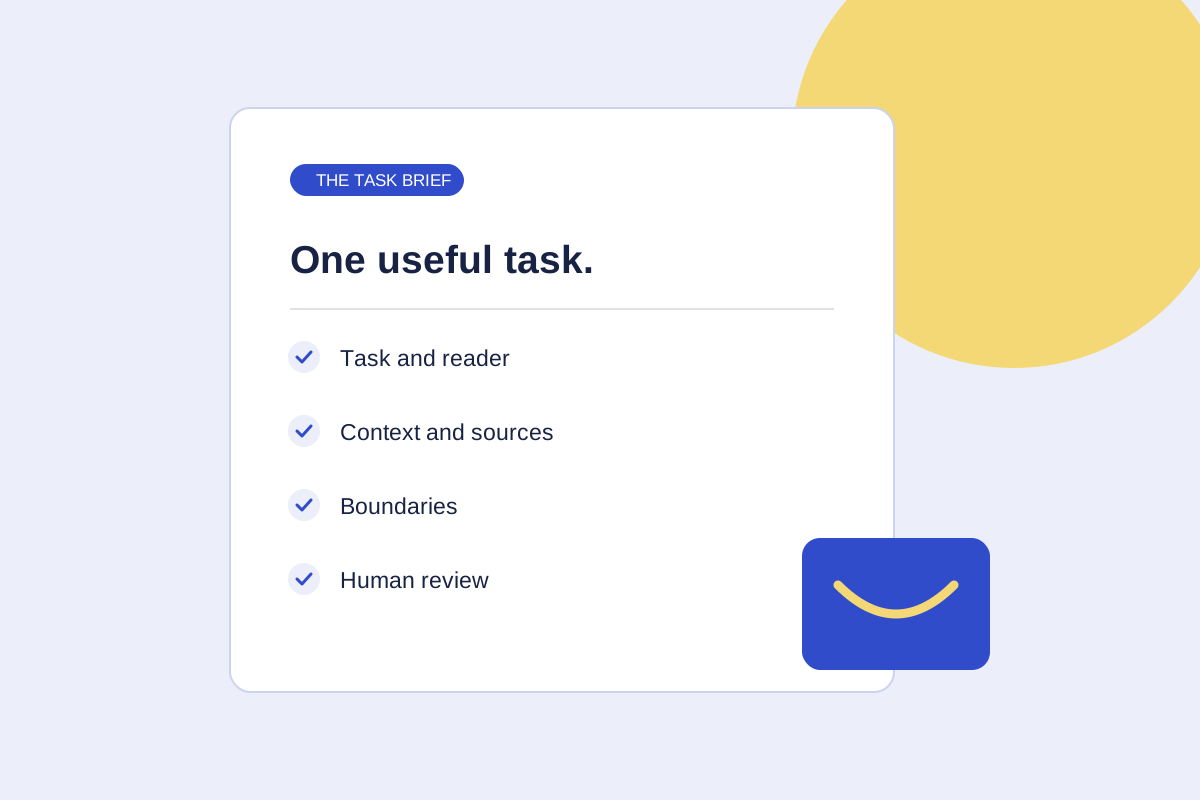
Name the task and reader
Say what you want to produce, who will read it and what it needs to help them understand or do. Specify the format and length if they matter. A request for a short event-page introduction gives the work a clearer shape than a request to help with marketing.
Choose the relevant context
Describe your charity and the purpose of this task. Add approved facts, existing wording and instructions the assistant should follow. Include only files you have permission to share, and leave out unnecessary personal details.
If a fact is missing, say so. Ask the assistant to flag gaps rather than fill them with plausible details. Ask for sources for factual claims and check those sources during review.
Make the boundaries explicit
State what the draft must include and what it must avoid. For example, an illustrative brief could read:
Draft a 150-word introduction for our community event page using the attached approved brief. Write for local families in plain English. Do not invent dates, costs or attendance figures. Flag missing facts and identify the source for each factual claim.
This describes drafting work. It does not ask the assistant to publish the page or administer an event.
Plan the human review
Name who will check the draft before anyone uses it. Review the facts, tone, permissions and suitability for its reader. Keep unanswered questions visible until someone can resolve them.
A source packet and draft
This example uses fictional Meadow Community Group. The source packet and draft are illustrative; missing facts stay visible.
Illustrative source packet
- S1: Meadow Community Group is preparing a community event for local families.
- S2: The event includes a seed-swap table and a craft activity.
- S3: Draft only; the group coordinator must review before use.
- Missing facts: Date, venue, cost, booking or contact route, and attendance figures.
Illustrative draft
Meadow Community Group is preparing a community event for local families. [S1]
The event includes a seed-swap table and a craft activity. [S2]
Date: [missing]. Venue: [missing]. Cost: [missing]. Booking or contact route: [missing].
The packet has no attendance figures, so the draft makes no attendance claim. It stays below the requested 150 words because no further event facts have been supplied.
Human review checklist
- Check every factual claim against its source.
- Resolve the date, venue, cost and booking or contact route before use.
- Add attendance figures only from an approved source.
- Check that the tone suits local families.
- Check sharing permissions and remove unnecessary personal details.
- Have the group coordinator explicitly approve the final text before use, as S3 requires.
Reuse the AI task brief
Set out the task, context, format, constraints and reviewer in the blank template. Keep missing facts visible until the reviewer can resolve them.
Copy or download this blank template without signing up. Complete it locally; nothing is submitted to Charitas. Before sharing, remove unnecessary personal details and check permissions.
Keep the completed task brief locally for scoping. Start here saves setup preferences; it does not accept brief uploads or publish draft work. Charitas services are in development.
Explore the Charitas workspace, or Start here to choose your workspace and AI preferences. Keep your task brief ready for scoping.